
India's Vaccine Schedule: UIP Guide for Clinicians
A clinical reference on the vaccine schedule India follows under the Universal Immunization Programme: antigens, timing, sourcing and stocking.
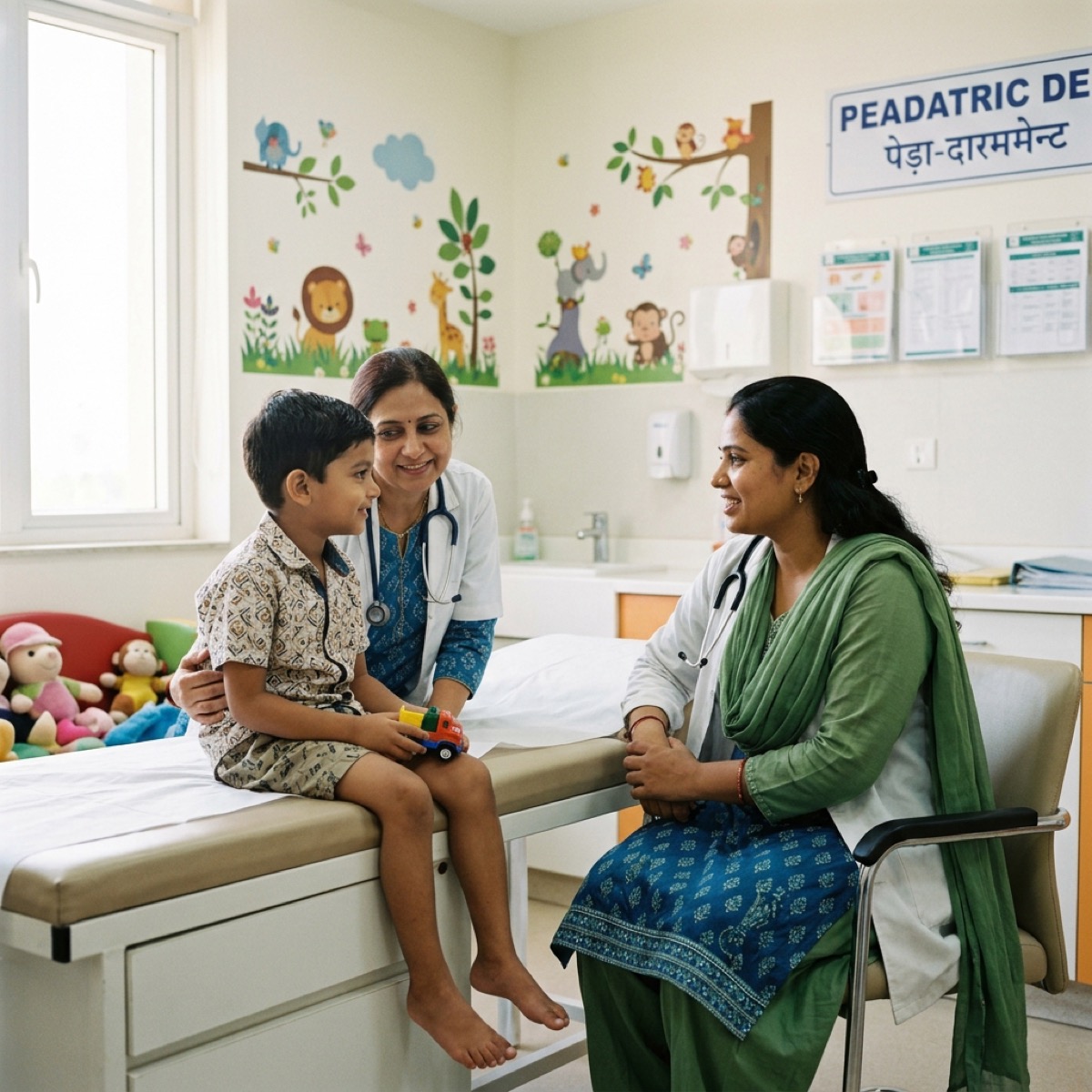
This covers the antigen list and timing structure, where the UIP and IAP schedules diverge, how vaccines move through India's supply and cold chain, and what a clinic's own stocking discipline means for a family that shows up on schedule.
What vaccines does the government schedule actually cover?
The Ministry of Health and Family Welfare's Universal Immunization Programme protects against tuberculosis, diphtheria, pertussis, tetanus, polio, measles, rubella, hepatitis B, rotavirus diarrhoea and Haemophilus influenzae type b nationally, with Japanese encephalitis vaccine added in endemic districts. It is one of the largest publicly funded immunization efforts in the world, delivered free at government health facilities as part of the Reproductive and Child Health programme.
BCG, OPV-0 and the first Hepatitis B dose are given at birth, with the pentavalent vaccine, covering diphtheria, pertussis, tetanus, Hepatitis B and Hib in one shot, given at 6, 10 and 14 weeks alongside OPV and rotavirus doses.
Where does the IAP-recommended schedule add to the government one?
The Indian Academy of Pediatrics publishes its own recommended schedule, adding vaccines like PCV and additional Hib and rotavirus formulations that a family can access outside the free government supply through private paediatric practice. Indian Pediatrics, the IAP's peer-reviewed journal, documents these as recommended rather than government-mandated, and a clinician needs to be explicit with a family about which category a given vaccine falls into.
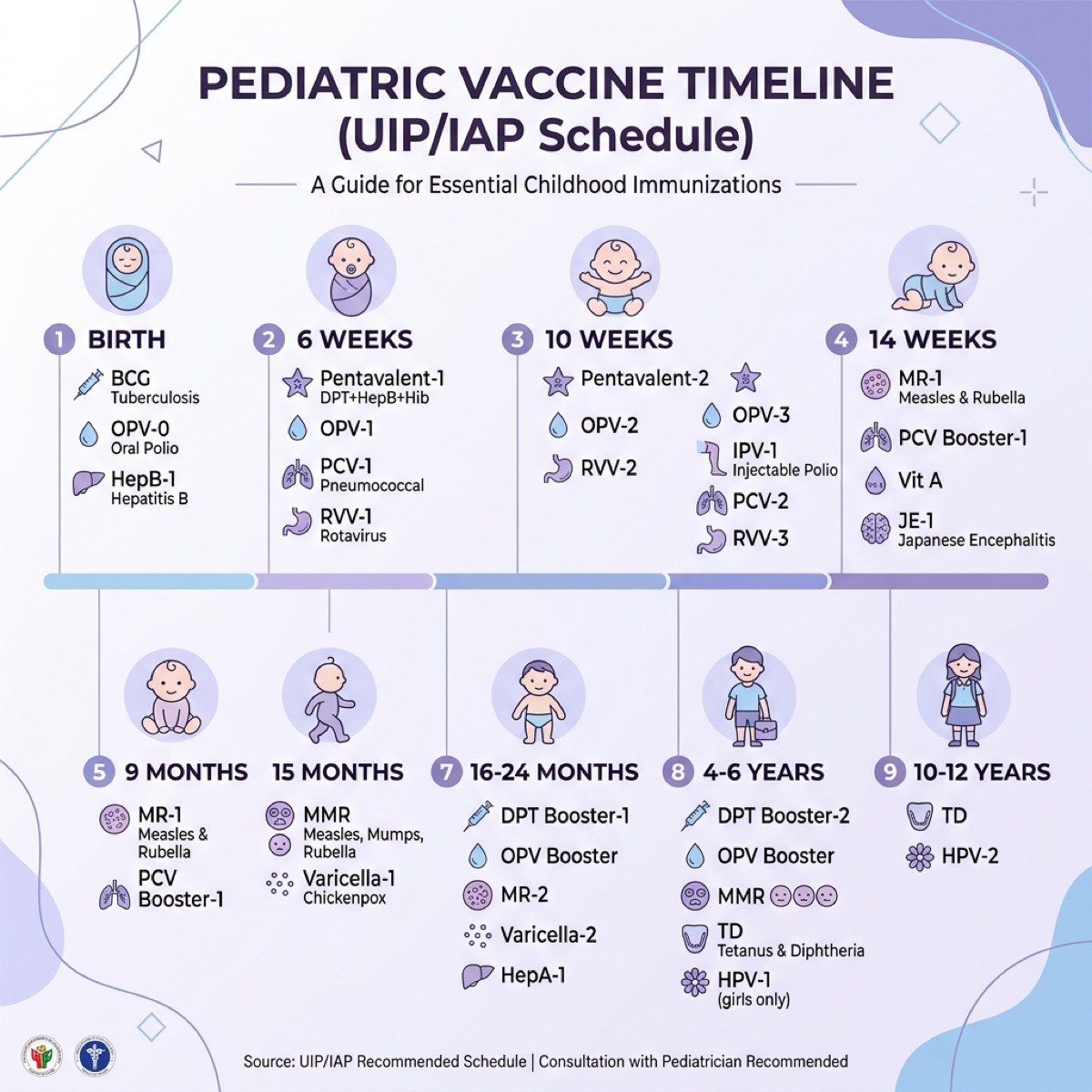
The measles-mumps-rubella combination is a common example of this divergence: the government schedule delivers measles-rubella at 9 months through UIP, while IAP guidance allows a paediatrician to use MMR instead at the same age window to add mumps coverage, a private-sector option rather than a government-supplied one.
What does WHO say about how national schedules should be built?
WHO does not mandate a single global immunization schedule; it issues recommendations through its Strategic Advisory Group of Experts on Immunization, and each country adapts timing to its own disease burden through a national immunization technical advisory group. India's UIP reflects this adaptation, with JE vaccine restricted to endemic districts precisely because national disease-pattern data, not a global default, determines where it belongs.
WHO's routine immunization tables set out minimum ages and intervals between doses for each antigen, which is the technical floor national programmes build from rather than a schedule any single clinic can shorten on its own judgement.
How does India's cold chain and supply system actually work?
UIP vaccines move through a government cold chain from national and state stores down to primary health centres and outreach sessions, and maintaining 2–8°C at every link determines whether a dose delivered in a remote block is still potent on arrival. A private facility administering UIP antigens is expected to match that same storage discipline.
Private-market vaccines outside UIP supply, including several IAP-recommended additions, move through standard pharmaceutical distribution rather than the government cold chain, which means a clinic sourcing both categories is effectively running two separate supply disciplines under one roof.
Why does a hospital or clinic's own vaccine stocking reliability matter?
A caregiver bringing an infant in for a scheduled dose has a narrow real-world window to complete it before the visit becomes a missed dose, a delayed schedule, or a walk to another provider entirely. Immunization is one of the few prescriptions where the appointment itself is the entire clinical event, so an out-of-stock vaccine at that specific visit is a lost visit, not just a lost sale.

A family redirected to an outside vaccination point for one missed dose often continues the rest of that child's schedule there too, which breaks both continuity of the paediatric relationship and the hospital's own outpatient revenue from years of subsequent visits. Our guide on prescription leakage and hospital revenue loss covers how a single stocking failure like this compounds across a patient relationship that was supposed to run for years.
Does a managed pharmacy model help a paediatric or immunization practice specifically?
A managed hospital pharmacy model applied to immunization stocking means the specific antigens a clinic's own patient base actually needs, in the doses its birth cohort demands, are tracked against real appointment scheduling rather than a generic monthly reorder. Vaccine stockouts are unusually visible and unusually damaging to trust precisely because a missed immunization date is a defined public-health event, not a vague inconvenience.
Our managed hospital pharmacy services guide covers how a managed model builds stocking around a facility's real patient calendar, which for a vaccine schedule India clinic means matching stock to birth-cohort volume rather than guessing. Our pharmacy inventory management guide covers the cold-chain-aware reorder and expiry discipline a temperature-sensitive product like a vaccine specifically needs.
Sources
- 1Universal Immunization Programme — Ministry of Health and Family Welfare, Government of India
- 2Recommended Routine Immunizations for Children — World Health Organization
- 3Why childhood immunization schedules matter — World Health Organization
- 4Recommended Immunization Schedule — Indian Pediatrics, journal of the Indian Academy of Pediatrics
- 5Know your child's vaccination schedule — UNICEF India
*Written by Dr. Anurag Sharma, MBBS, MS (Orthopaedics) — Consultant Orthopaedic Surgeon and Assistant Professor at S.M.S. Medical College and Hospital, Jaipur. Last updated 23 July 2026.*
*This article is a clinical reference for prescribers and hospital administrators. It is informational only, is not a substitute for professional medical advice, and does not recommend a vaccination schedule for any individual child. Consult a qualified paediatrician or physician for patient-specific decisions.*
FAQ
Frequently asked questions
BCG, OPV, Hepatitis B, pentavalent, rotavirus, PCV, measles-rubella, Vitamin A supplementation, Td and JE vaccine in endemic districts are all provided free through the Universal Immunization Programme at government health facilities.
The government UIP schedule is the free, publicly funded minimum; the IAP schedule adds recommended vaccines like additional PCV or Hib formulations and MMR as options a family can access through private paediatric practice, not government-mandated additions.
At birth, a newborn typically receives BCG, the first Hepatitis B dose and OPV-0 under the Universal Immunization Programme schedule.
No. JE vaccine is included in the schedule only in districts where Japanese encephalitis is endemic, based on national disease-surveillance data rather than as a universal nationwide dose.
Vaccines lose potency outside their required temperature range, typically 2–8°C, at any point between government vaccine stores and the point of administration, so a break in cold-chain discipline can render a dose ineffective even if it looks physically intact.
Dr. Priya MenonMBBS, MD (General Medicine)
Consultant Physician (Internal Medicine)
Dr. Priya Menon is a consultant physician in internal medicine, writing on drug classes, side-effect profiles, and evidence-based clinical use for hospital and prescriber audiences.